





 Michael Subins
It’s no secret the mobile app market keeps getting more competitive — hundreds of new apps hit the App Store every day, and standing out is more challenging than ever. User acquisition costs are going up, and platform algorithms are constantly shifting, making the game trickier for developers.
In a dynamic market like this, promoting your app in the App Store takes more than just running ads or updating metadata. You need a smart, well-rounded approach — and that means understanding how different marketing tools work together.
Two key tools that companies use to attract users are App Store Optimization (ASO) and Apple Search Ads (ASA). These channels can work well together — or compete with each other, leading to something called traffic cannibalization.
In this article, we’ll break down what traffic cannibalization is, how to spot it, how to measure it incrementality, and how to combine ASA and ASO for the best possible results when promoting your app.
Cannibalization vs. Protection Against Competitors
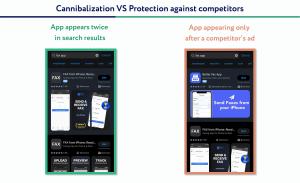
The image above shows two different scenarios. The green frames highlight cases where the Fax the Iphone appears twice in search results — both as a paid ad (ASA) and as an organic result (ASO). The orange frame, on the other hand, shows Fax the Iphone appearing only after a competitor’s ad.
In the first case, the app is protected — it shows up in both ad and organic placements, increasing the chances of a download. In the second, the app isn’t protected, which means users might end up downloading a competitor’s app that shows up first.
Now let’s look at a different situation — when the app you want to protect doesn’t look like a direct competitor to the one above it.

The green frames highlight Airbnb dominating the entire first screen, while the orange frame shows the second screen — where Airbnb disappears, and Holiday Lettings takes its place. While this means the second screen isn’t protected, Airbnb’s strategy still makes sense. Since this is a branded search, users are specifically looking for Airbnb by name, and given that Holiday Lettings is a different type of app, it’s unlikely those users would choose Holiday Lettings.
This raises a common question for popular apps: is it worth running ads to protect your top spot on the App Store if you’re already ranking high organically? And could those ads end up “stealing” traffic you would have gotten for free?
When paid ads start pulling in users who would have downloaded your app organically anyway, that’s called cannibalization.
The first step is to decide what matters most for your app — profitability or protecting your search results. One way to determine this is by analyzing your competitors. If their apps are very similar to yours, there’s a good chance they could attract your audience, even if users started by searching for your app. In that case, investing in ads to secure your placement can help prevent potential customers from drifting toward a competitor.
If your brand is well-known, users searching for your app are unlikely to be swayed by a competitor’s ad. In that case, you can skip protecting your placement and focus on other strategies to grow your traffic.
It’s also worth factoring in DEVELOPER and STORY cards and other elements that may show up in search and affect how visible your app is.
The smartest move is to evaluate each keyword and each country separately — then decide whether it makes sense to bid and protect your search results.
ASA Analytics vs. Search Traffic
The main metric to look at when analyzing search traffic is First-Time Downloads. You can find this data in App Store Connect under App Analytics — just apply the Source Type filter and select App Store Search. Keep in mind, this includes both organic installs and installs that came from Apple Search Ads.
To see just the downloads from ASA, check the New Downloads metric in your Apple Search Ads dashboard.
It’s important to understand the difference between these metrics:
- First-Time Downloads (App Store Connect) = Organic + ASA
- New Downloads (ASA) = Downloads from ad campaigns only
- Installs in ASA = New Downloads + Redownloads (when users reinstall the app)
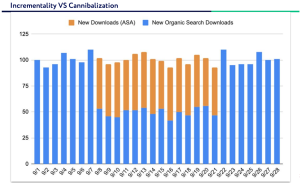
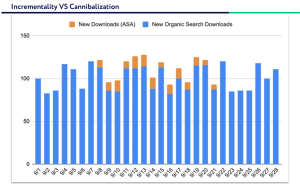
To estimate pure organic traffic, you need to calculate New Organic Search Downloads:
New Organic Search Downloads = First-Time Downloads – New Downloads
This gives you a better picture of how many users found your app on their own — without ASA.

 Sofia Savchenko