


Blog / Category: App Marketing. Autor: Alex Vereshchagin. / Naming Travel Apps

Naming Travel Apps

10 min.
8.May.2025

Hundreds of new apps are published in mobile stores every day. With so much competition, it’s crucial for developers to make their apps stand out. One way to achieve this is by coming up with a unique, memorable name. A well-chosen name can leave a strong first impression and play a key role in building brand recognition down the line.

A smart naming approach blends marketing, psychology, linguistics, and visual communication. Top app developers typically start the naming process by diving deep into the niche: researching the market, target audience behavior, and the competitive landscape. A key step in the naming process is legal screening — checking for available trademarks, making sure domain names are free to use, etc.

When working on app names, it’s especially important to consider the unique naming patterns in each app store category. In the Travel category, we’ll take a closer look at phonetics, melody, associations, common naming models, and the use of keywords. We’ll focus in particular on the Roadtrips and Trip Planning subcategories. We’ll analyze which words appear in app titles, whether they’re part of the brand name, and why developers choose them. The goal is to spot trends, identify recurring patterns, and offer practical tips for successful naming in this category.

Apps we analyzed:

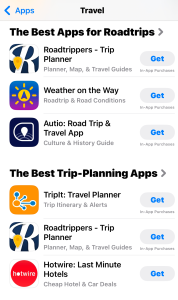
  • Roadtrippers – Trip Planner
  • Weather on the Way
  • Autio: Road Trip & Travel App
  • Roads by Porsche 
  • Wanderlog – Travel Planner
  • inRoute – Intelligent Routing
  • Roadie: Road Trip Planner & RV
  • Triplt: Travel Planner
  • Travel Planner Guide: Tripsy
  • Tripomatic Trip Planner & Maps
  • Steller: Plan & Book Trips
  • Tripadvisor: Plan & Book Trips
  • Nowy: AI Travel Content Planner
  • Trip Scout – My Travel Planner
  • RoadWarrior Route Planner

Visual analysis

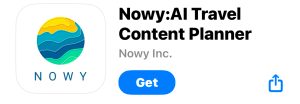
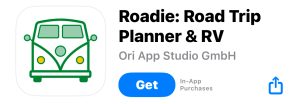
Visual optimization is a key element that works hand in hand with naming. Just like the app’s name, the icon shapes users’ first impressions, triggers associations, and influences brand recognition. Looking at app icons in the Travel category, we can see that most of them visually reflect the theme: location markers, roads, and navigation arrows are commonly used. For example, Roadtrippers combines the first letter of its name with a location icon. The Roadie app icon features a van, pointing to the idea of travel. Nowy highlights its name by including the logotype in its icon. TripAdvisor stands out with its signature logo that combines an owl and wheels — a combo that makes the app instantly recognizable. And the inRoute icon draws attention to a stylized “R” that’s closely tied to the brand.
Most icons stick to simple shapes and clear, themed visuals. Details are kept to a minimum since small features can get lost on smartphone screens and make an icon harder to read. Minimalism, on the other hand, helps with recognition: bold, easy-to-spot shapes are easier to notice and remember, especially with so much competition on the app stores.

Effective visual elements for Travel app icons are fairly limited — maps, compasses, cars, roads, luggage, globes, and curved lines. Still, even with this small set, it’s possible to stand out and capture your app’s vibe through an icon. This is important because emotional response always drives more interest and makes an app more appealing to users. Icons can also be tweaked by season — using colors that match the time of year — or updated with timely elements connected to current events. Just keep cultural differences in mind: what works in one region might come across differently in another.

A great example of strong visual optimization is Duolingo. Its app icon features the brand’s playful mascot, Duo, who changes expressions depending on the context. Recently, the company jumped on a trending moment by showing Duo in an accident with a Cybertruck. According to Similarweb, the campaign led to a 25% increase in active Android users compared to the previous year. On iOS, the day of Duo’s “death” saw record downloads — up 15% from the average, hitting 172,000 installs.

This case study shows just how powerful timely, bold responses to cultural trends can be. There’s room for that kind of creativity in the Travel category too — the kind that resonates with users and grabs attention. The key is not being afraid to experiment. One thing to remember: a static brand is a dead brand. While a brand that feels alive, even if it “dies” for a moment, can spark new interest and break download records.
Achieve growth with our expertise and unique tools

Let’s connect

Analyzing sound, rhythm, and melody

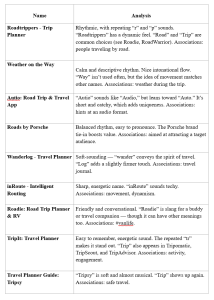
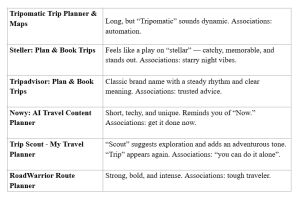
Most names are rhythmic and punchy, with repeated sounds or clear stressed syllables. They often use strong consonants (T, R, P, D, G) and vowels to create a melodic feel.

Some names have a strong rhythm thanks to their syllable structure:

  • Road-tripp-ers (3 syllables, clear stress)
  • Wander-log (2 syllables, balanced by strong first stress)
  • Trip-o-mat-ic (4 syllables with a melodic “-ic” ending)

Words that show up a lot:

  • Trip/Travel/Road – highlight the theme.
  • Planner/Guide – point to the app’s function.
  • Log/Scout/Warrior – add character.

Most app names include words like “Trip,” “Road,” “Travel,” and “Planner.” Some publishers even build these keywords right into the brand name — like TripIt or TripScout — pointing to a clear trend in naming.

  • “Trip” at the beginning: TripIt, TripScout, Tripomatic
  • “Road” at the beginning: Roadtrippers, Roadie, RoadWartior.

The more unique the name, the higher the chance it’ll stand out (Steller, Nowy, Autio). But there’s a fine line — go too far, and you risk losing the connection to the category. Apps with highly original names usually need to invest in brand promotion beyond the app stores. A nice-sounding name alone won’t do much without a budget to build recognition.

Analysis of naming constructions

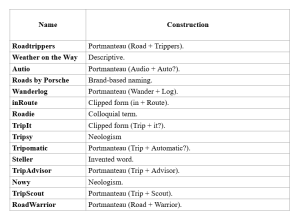
The key difference between clipped form and portmanteaus is how much the original words are shortened or altered. Clipped names keep part of the meaning but lose the full word, while compound names keep both components recognizable and intact.

Most publishers go with a name structure like main word + modifier (e.g. Roadtrippers, TripScout, RoadWarrior). Short, unique names are rare. Blended/compound names, neologisms, and clipped forms are much more common.

Formula for a successful Roadtrip app name

  1. Main word: Trip/Road/Travel Route
  2. Add-ons:
    • Boosters: Warrior, Scout, Log
    • Automation hints: -matic, -It
    • Friendly tone: -y, -ie
  3. Imagery:
    • Tech references: AI, Smart, Auto
    • Movement-related words: Way, Guide
  4. Structure types:
    • Compound word: Tripomatic, Wanderlog
    • Clipped word: TripIt, inRoute
    • Unique coinage: Nowy, Steller

Let’s try coming up with a name for an app using this formula.

Imagine the app is designed for people who don’t have much time to travel. They work a lot, earn an average income, and have families. Their only chance to travel is a quick day trip somewhere nearby. What matters most to them is feeling confident that the route is safe — and hearing their loved ones say, “Wow, this place is beautiful! We had no idea this was even here!”.

  1. Main word:
    • Trip/Road/Travel/Route
    • Or something that suggests speed or short-term experiences: Short, Quick, Blink, Snap
  2. Add-ons:
    • To highlight the format: Day, Flash, Spot
    • To hint at emotion: Wow, Joy, Magic
    • To suggest simplicity: Easy, Safe, Smart
  3. Imagery:
    • For energy and movement: Rush, Dash, Go
    • For comfort: Home, Safe, Easy

Name ideas:

  • QuickTrip – a short, fast getaway. Clear and straightforward..
  • DayWow – one-day trips that leave a “wow” impression.
  • FlashTrip – super quick travel. Snappy and rhythmic.
  • EasyDayTrip – simple and transparent.
  • SafeRoute – a safe route for the whole family

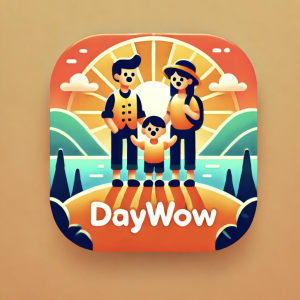
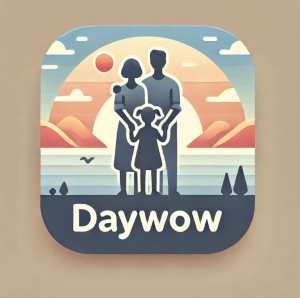
If this were a real app, I’d go with the name “DayWow” — it brings to mind the word “day off,” which fits the app’s purpose. I’d pair it with a keyword like Trip Planner to make the function clear. The name captures the idea behind the project and speaks to people who want to travel but are short on time. For the icon, I’d use soft pastel colors and show parents holding hands with a child, with a backdrop of the sea and a rainbow or sun — a symbol of safety. In different regions, I’d swap in local landmarks in the background.

Pastel colors combined with a bold name would create contrast and draw extra attention. Even if the app isn’t relevant to a user right away, that combination is likely to make an impression. The design would reflect a sense of calm and comfort — just right for relaxed family day trips.


AI-generated suggestions for an A/B test. Shall we give it a go?

Like this breakdown? Feel free to reach out — I can conduct a similar analysis for your app category.

Written by

Alex Vereshchagin ASO Lead alexv@angletech.ai The ASO Lead at Angle Agency specializes in mobile app optimization for international markets, with expertise in East Asia and Austronesia. Consults on app development, lectures at Asodesk Academy, and has authored books with Ves’, IPIO, and Eksmo since 2016. Outside of work, enjoys composing music, hosting a podcast on learning the Indonesian language, reading, subtitling, and dubbing Indonesian films, and video production. All articles by author

Also read: